


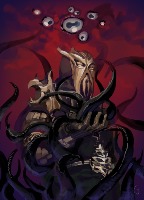
Being an evil character doing evil deeds may not be comforting for some players after many players who tend to play good alinged characters will have trouble with actions such as torture, and murder of the innocent even if is for the greater good. Something to remember even though most villains are self-serving monsters this does not mean they can't can band together, have loyalty, camaraderie, even love and all that stuff. They can have patience, temperance, mercy, compassion, as well. If a Villain does show mercy or even compassion this normally is due to their own personal experience, they have something to gain from it, or even due to having a sense of honor. But we will review the alignments of Evil. These descriptions are rather wordy but see the notes from me for a much simpler summery of the alignment. You may also wonder this question "how evil are we allowed to be?" short answer as evil as you wish to be. This campaign will reflect the wages of your sins don't worry. Lawful Evil: All the problems chaotic evil societies have are not problems for lawful evil. Chaotic evil is the cycle gang who kicks down your door, steals your stuff, burns your house and deep-fries your puppy dog - then leaves. Lawful evil is a faceless bureaucracy that seizes your house through eminent domain laws, confiscates your property with a court-ordered foreclosure, puts your puppy dog to sleep because he wasn’t registered, and then offers to rent your old house back to you at a reasonable rate. Lawful evil is organized. Violence is the last resort, after it’s tried blackmail, bribery, threats and devious backroom political maneuvering. Chaotic evil hates to back down from an open fight. Lawful evil hates open fights: it would much rather sneak into your bedroom, cast a sleep spell on you to make sure you’re really out, then put a pillow over your face. So much tidier. Lawful evil societies have far, far greater potential for longevity and growth because they’re based on obedience, order and deferring gratification. Where chaotic evil wants it now, lawful evil wants it all, and if it has to wait ten years to wear you down, it’s got a clear calendar. It’s simple to take down a chaotic evil society: you just kill the boss. (This may not be easy, but it’s simple.) Rarely is it that straightforward in a lawful evil society, because the structures of the society are what make it evil. Cut down one corporal in the army and another comes straight out of the military academy to take his place. Lawful evil might have a few noteworthy individuals who serve as champions and leaders, but they don’t rely on them the way chaotic evil does. You can hack a few branches off, but the tree is still there. For instance, imagine a society that holds that “Only old male humans are worthy of respect.” If you fall outside those three categories it’s okay for any old male human to rob, enslave or imprison you. If you’ve got one of those traits, you’re better off than those with none, and if you’ve got two you’re almost a citizen - but not quite. The old male humans have got a good thing going, so they support the system. The old male elves and dwarves are second class citizens, but they’re still better off than young women, so they can’t complain too much. But if you’re a young halfling woman, you better not show your face in public because you have no legal recourse for anything anyone wants to do with you. Conquering a lawful evil society is no picnic because they plan, organize and obey their superiors. Lawful evil societies are built on the idea that individuals are tools. There is nothing unique or special about any particular hobgoblin in the army, so the strategies and tactics of the lawful evil mob are based on the idea that any individual can do it. They tend towards fortifications, siege engines, phalanxes and defensive technologies like shields and armor. Note from the DM: The first part of this adventure will result in breaking out of Branderscar prison when then our villains will then seek revenge on the nation that had imprisoned them but one may ask "how is this lawful?" short answer it's not. Lawful evil is the recommended alignment not because your character is obeying the laws of Talingarde but because your characters seek to impose a new order. This is not the campaign for chaotic loners or freespirited vagabonds (though these villains are recommended to be able to work with the group if used). Those campaigns exist in abundance and if they are what you are looking for, perhaps you are in the wrong place. This is a campaign about joining an evil organization with a wicked agenda. Eventually, you may even come to control that evil organization. “Way of the Wicked” is a chance to play an unusual sort of character. You will play a burgeoning dark lord -- someone who will rise from imprisonment and destitution to become one of the greatest villains of this age. At first, you will be a minion in service to a sinister plot. But eventually, you will be a minion no longer. You, if you can survive, will become the master. And that is almost the definition of lawful evil. And Like Lawful good - Lawful Evil does not mean Lawfully Stupid. what this means is they know what they want and will manipulate the system (legal, cultural, and so forth) to achieve those ends, no matter the consequence. This can be for personal gain (for example, the traditional evil vizier who seeks to claim the kingdom for himself) or to better society at all costs - the "I know what's best for everyone else"-attitude without any of the compassionate limits to action found in lawful good Neutral Evil: Unlike either chaotic or lawful evil, the neutral evil organization both respects laws, and tries to find a way around them. There is structure, but it is loosely created and even less adhered to. The ideal situation for a neutral evil ‘person’ is one in which he can convince the opponent to abide by the rules - all the while, breaking them himself. They are hypocrites, two-faced dealers that provide a backdrop for their gains, and then destroy their own rules whenever it becomes troublesome to deal with them. In many games, the neutral evil character is rightfully described as ‘Neutral Me.’ Their number one goal is not simply to acquire power, or riches, but to grasp anything that they desire. After they have gained it, they may well forget about it and move on - once its usefulness is finished, or the thrill of the acquisition is gone. Chaotic evil wants it now. Lawful evil wants it all. Neutral evil simply wants it, and will go to any lengths, including patience, outright bartering, or even working with a good party to get it. The neutral evil villains do occasionally keep their word and stick to contracts - when it is in their best interest. Where you can trust chaotic evil to rampage, and lawful evil to tyrannize, you just can’t trust neutral evil will do anything. They even break their own rules. Unlike chaotic evil, they have no problem with impulse control - they can machinate with the best of them. Unlike lawful evil, on the other hand, they have no desire to organize or conform, and can adapt their plan and their nature as suits the situation. While this can make for an extremely powerful individual, neutral evil societies are rare and short-lived. People with neutral evil tendencies rarely care enough to gather in groups, unless the payoff is rich. They almost never create established communities, or form organized and structured government systems - what would be the point? They would all ignore it, machinate the rules, and eventually destroy the society they had created. A neutral evil individual prefers to find an existing society, and abuse its laws and systems for their own gain, all the while pretending to adhere to their structure. This allows the neutral evil to have an advantage over the indigent residents, who actually do follow the laws and rules, and won’t see the neutral evil’s plan coming until it is too late. Then, after the neutral evil individual has taken everything he wanted, he moves on and finds another society to exploit. Good, evil, beneficent or malevolent - it doesn’t matter, so long as the neutral evil gets whatever he was searching for. The occasional small neutral evil society that does form must have some other reason to stay together. Family units, parasitic creatures, or other systems where the group is more powerful than the individual can work, but only so long as all parties know that they would not be better off alone (or if they cannot exist apart). In such circumstances, the leader is often the individual who can manipulate the others into supporting him, or whose personal ability outshines the others. Even so, he should always be aware that the rest of the society is looking for ways around his command, and to “slip the bonds” of his control. Conquering a neutral evil society is a laughable prospect. First, they aren’t organized enough to “conquer.” If you march in and claim the area, they will certainly agree with you - and then quietly assassinate your generals, commanders, and whoever else needs to be removed in order for you to leave them alone. Ordering tithe or obeisance from a neutral evil group will bring you a great deal of polite lip service, at least until such time as you realize their shipments of grain were poisoned, and now your peasants are dying by the score. Neutral Evil doesn’t need pride, and it doesn’t need to be “respected.” it isn’t going to fight you face-to-face, and it won’t burst into a rampage! of chaotic slaughter when you trigger its anger. It will smile politely, bow, and then stab you in the back when you least expect it. It will find your weak link, and exploit it. The dagger in your back might be held by your dear wife, convinced that you are a shapechanger, or even from your closest friend. The worst part is that the neutral evil individual has most likely convinced these people that they are doing it “for your own good.” All behind the scenes, of course, and carefully ignoring only the rules that would constrict his actions. Note from the DM: In short neutral evil promotes pain, anguish, misery, corruption, and destruction on all, without regards to the individual (chaos) or the system (law). This can be for its own sake or for a definite goal, including bringing the end times (either to end the world or to bring about its replacement with a 'better' world) or raising an evil master to power or freeing one from containment. For example Drow elves form some of the most organized, powerful and largest neutral evil societies if not empires known. Even though most of these nations/houses/clans worship demon lords their patrons just require them to be within one step of their alignment and thus most drow are neutral evil. Keep in mind that although lawful evil is preferred neutral evil will work well with the party since they may be less incline (only less) to backstab his comrades. Chaotic Evil: With chaotic evil, the unifying factor is “fear of the big guy” (just as with chaotic good, the unifying social factor is “desire to look out for the little guy”). Chaotic evil has a reputation as “the eeeeevilest evil” because the big booty-trouncing red dragons and Unspeakable Demons from the abyss were chaotic evil. Maybe there’s a connection, but it works in the other direction. Big Red isn’t powerful because he’s chaotic evil. He’s chaotic evil because he’s powerful. When you can win any argument by saying “Hey, talk to the 14-die breath weapon,” there’s not a lot of incentive to be organized or reasonable. Chaotic evil is lazy evil: It gets things done in the simplest possible way. Chaotic evil can also be considered “efficient evil.” Coveting your neighbor’s house? Conk him over the head and move in! Don’t like the adventurers creeping into your dungeon? Waste ’em! Nothing troubling you at the moment? Take a nap! Like every other alignment, chaotic evil types tend to hang out together because they understand one another. These groups don’t have a lot of rules or formal structures. The boss is the boss because he gets things done and is strong enough to bend others to his will. The underlings want to be in charge, and one of them will probably get ambitious enough to attack the leader eventually.. . assuming the leader doesn’t crush him first. A society based on violence and poor impulse control has some built-in limits to its size. No matter how powerful a leader is, his number of followers is limited to those he can personally awe or bully. If the followers eat to live (as opposed to demons, who only eat for the fun of it), the number is far more limited, because chaotic evil types don’t have the patience to farm or the organizationalskills to make slaves do it. Basically, chaotic evil groups are like biker gangs in those old 1950s scare flicks. They’re tough, they’re mean, they’re unpredictable, they ride in and seize what they want, but they don’t stick around because they really can’t. Once they’ve stolen whatever they can carry, there’s no reason to stay: They’re off to the next town ripe for the picking. Individually, chaotic evil beings tend to be the toughest because they’re more likely to do crazy stuff like fight to the death or meet a massed charge with a massed charge. Their tactics tend to be built around mobility, surprise, and overwhelming offense. But because they burn twice as bright, they only last half as long. These problems only get amplified in a society where everyone’s looking out for number one, and there’s no stated or implied punishment if you successfully kill the boss. Chaotic evil gangs tend to scatter when the leader dies, and if you negotiate with the underlings it doesn’t take long to find someone who’d love to slit the chief‘s throat - if he thought he could get away with it. As individually tough as they are, chaotic evil societies are among the easiest to take apart. Methodical patience and a willingness to play the inevitable factions off against each other can be the party’s greatest allies when dealing with such groups. Note from the DM: In short chaotic evil is all about self aggrandizement and fulfilling the individual's desires no matter the cost to anyone else. This ranges from the mad monk, who seeks to return insane outer gods so he may rule what is left of the world, to the armored bully, who enforces his will through brute force and intimidation. How ever chaotic evil can be charming and urbane, but brooks no resistance to its goals except those imposed by a stronger force. Even then, it schemes to remove the obstruction without any personal sacrifice.