


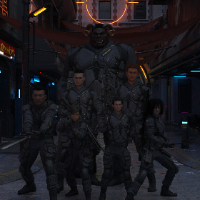
With the alliance of the Triad and the new world government formed, the team has discovered that the Zier'ta'Kal already have a foothold on Earth and have set up a base of operations under Babylon. The tunnel that they used has been sealed behind, but there is a network of caverns and tunnels underneath that part of the world that might possibly lead the team to their base. Without knowing the time you're going to spend down there, the group will need to gather supplies and given the uncertainty of the terrain, most drones will not be able to accompany you. Climbing gear, light sources, and food and water are all going to be essential. Close quarters combat will probably serve the group better than ranged. Meal Pack (TL9) These packaged meals have little weight or volume, yet supply the nutrition and calories needed to keep a person active for extended periods. Although long-term use could cause some discomfort or weight gain, they are usually tasty and provide enough variation for almost everyone to have a favorite. Stored meal packs have a safe shelf-life of 10 years. They come in dozens of variations, with randomly selected main courses, side dishes, and dessert. The packages can heat or cool themselves, and are sealed against the outside environment. $2, 1 lb. per meal. Higher-TL meal packs have the same weight, but possess a longer shelf-life: 20 years (TL10), 50 years (TL11), or 100 years (TL12). Survival Rations (TL9) These are designed to put the maximum amount of nutrients into the smallest sealed package; the flavors are limited. They have a safe shelf-life of 15 years, provided the package is not tampered with. Each meal is $5, 0.5 lbs. Higher-TL rations taste somewhat better (but do not match the flavor of meal packs), and possess an extended shelflife: duration is 30 years (TL10), 70 years (TL11), or 150 years (TL12). Flashlights and Searchlights (TL9) These can project an infrared, ultraviolet, or visible light beam, which is also tunable from a wide flashlight cone to a pencil-thin red or blue-green laser pointer (range is multiplied by 10). It can function as a blinding weapon in a pinch – see Dazzle Laser (p. 113). The light eliminates darkness penalties out to its listed range. Use 75 times this distance for signaling range. Multiply all ranges by 2 at TL10, 5 at TL11, and 10 at TL12. Penlight (TL9): This emits a five-yard beam. It may be helmet or belt-mounted, or attached to a firearm accessory rail. $3, 0.1 lbs., 2A/24 hr. Mini Flashlight (TL9): This projects a 15-yard beam. May be helmet-mounted or attached to a firearm accessory rail. $10, 0.25 lbs., B/24 hr. Heavy Flashlight (TL9): This projects a 50-yard beam, and can be used as a baton. $20, 1 lb., 2B/24 hr. Searchlight (TL9): Heavy-duty searchlights are often mounted on vehicles or buildings. A searchlight projects a 2,000-yard beam. $500, 10 lbs., C/12 hr. LC4. Glow Sticks (TL9) These chemical lights glow when snapped and shaken; they don’t require power cells. Each provides (TL-8) days of light illuminating a two-yard radius. They’re available in different colors, white light, and infrared light. $2, 0.1 lb. Envirobag (TL9-12) This is an insulated, heated sleeping bag designed for extremes of temperature. It has the same performance as a Heat Suit (p. 177). It can also be sealed and hooked up to air tanks. TL9: $160, 3 lbs., C/24 hr. TL10: $80, 2 lbs., C/72 hr. TL11: $40, 1.5 lbs., C/10 days. TL12: $20, 1 lb., C/2 weeks. Filtration Canteen (TL9) This canteen holds a quart of water. It removes impurities, salts, microbes, and poisons. It can filter salt water, but not raw sewage or toxic waste. On its own, it adds a +1 (quality) bonus to Survival skill when living off the land; it’s also included in survival kits. One quart can be purified in 30 minutes (TL9), 10 minutes (TL10), three minutes (TL11) or instantly (TL12). The filter must be replaced every 100 quarts at TL9, or 1,000 quarts at TL10; a color change signals when it’s time to change. An “exhausted” filter still has a few quarts of capacity, but only the GM knows how many. At TL11-12, the filter is permanent. The canteen is $180, 1 lb. (empty) or 3 lbs. (full). LC4. Gripboots (TL9) This smart climbing footwear is amazingly tough, but still provides tactile feedback about the rock conditions to the wearer. In addition, the boot can change shape for a better grip, and can grow crampons or a forward-placed spike on command. Add +1 per die to the damage the wearer inflicts with a kick. Gripboots give a +1 equipment modifier to Climbing, or +2 on ice. Combat statistics are identical to assault boots (p. 173). $500, 2 lbs. LC4. Rocket Piton (TL9) A pistol-grip launcher which fires a rocket-propelled, explosive-set piton. It can shoot an attached line up to 200 yards. A successful Climbing roll (made by the GM) means the piton is securely lodged and will support weight; a critical failure means the firer only thinks it is! Roll vs. DX-4 to hit if used as a weapon. It inflicts 1d+2 impaling damage, with Acc 2, range 70/200, RoF 1, Bulk -3, Rcl 2, Shots 1(5). $40, 2 lbs. Reloads are $1, 0.5 lb. per shot. LC4. Smart Pitons (TL9) A piton is a spike with a ring on it, through which a rope can be run. High-tech pitons adjust to the shape of the crack they’re in, and report on their status via an integral microcommunicator. They come free on command. While a piton will report if it is obviously loose, it cannot check its own stability under load, so the climber must also do a manual check. Used properly, they give +1 to Climbing skill. 10 pitons: $100, 1 lb. LC4. Splat Piton (TL9) This two-inch sphere has a ring attached for a rope. When broken against rock or another hard surface, a fastdrying glue is released. In one minute, the ring can safely support 16 tons. The sphere may be fired out of a mortar as far as 50 yards, unreeling a light line. The line unreeled must be used to pull a climbing rope through the piton ring. If a climbing rope is launched, range drops to 10 yards. A catalyst can unstick the glue, allowing the piton to be removed. It is not reusable. $10, 0.05 lbs. LC4. Vapor Canteen (TL9) This canteen draws moisture from the atmosphere. How quickly it works varies with the amount of water vapor in the air – with an Earth-standard humidity of 50%, the time required to extract a quart of water is four hours (TL9), three hours (at TL10), two hours (at TL11), or one hour (at TL12). It has a capacity of one quart, and adds a +2 (quality) bonus to Survival skill for an individual living off the land. $450; 2 lbs. (empty) or 4 lbs. (full), B/100 quarts. LC4. Vapor Collector (TL9) A larger version of a vapor canteen for base camps, settlements, etc. It is 60 times faster, producing one quart every four minutes at TL9. It is standard for expeditions and military or police outposts; it frees them from the necessity of establishing a post near a water source. Sabotaging the vapor system is a favorite ploy of villains in adventure stories. The plot is so hackneyed that real adventurers laugh at it, and may not be prepared if it happens. It adds a +2 (quality) bonus to Survival skill for a group living off the land. Usually connected to a water tank, but has an internal capacity of 20 quarts (five gallons). $10,000, 120 lbs., E/30 days. LC4. Rope (TL9) These are synthetic lines and ropes made of polymer fibers or artificial spider silk (TL9), carbon nanotubes or biphase composites (TL10), or even more exotic materials. 1/8” diameter (TL9): Supports 400 lbs. 10 yards of line: $2, 0.1 lb. 3/16” diameter (TL9): Supports 1,000 pounds. 10 yards of rope: $5, 0.25 lbs. 3/8” diameter (TL9): Supports 4,000 pounds. 10 yards of rope: $20, 1 lb. 3/4” diameter (TL9): Supports 16,000 pounds. 10 yards of rope: $80, 4 lbs. This is the safe working load; the theoretical breaking strain is five times as much. If exceeding the safe load, roll vs. the rope’s HT 12 at -1 per multiple of working load whenever it is stressed to see if it snaps. Strength doubles each TL after introduction. Anything that the group is taking with them will need to be specified on your character sheets.